


.jpg)
From 7–10 October 2025, the 19th European Forest Pedagogics Congress was held in Visegrád, organized by the Hungarian Forestry Association (Országos Erdészeti Egyesület) in cooperation with the FAO FCN forest pedagogy sub-group. The choice of location was no coincidence, as the organizers specifically wished to present to participants from 16 countries Hungary’s – and Europe’s – first forest school.
The motto of the Congress was: “Forest pedagogy: a tool for educating for (offline) life”, and the lectures and workshops of the event were organized around this theme. In addition to the professional program, activities introducing Hungarian culture and local natural assets were also part of the event.
The starting point of the conference theme was that many are already sounding the alarm that children spend too much time in front of screens. Yet few want to hear this, because when a child plays quietly with a device, there is peace and calm. It is difficult to break out of this situation for both adults and children.
However, the developing brain, the development of attention and social skills, and sleep quality are all sensitive to digital overload. Medical and psychological research is increasingly precise in showing when and how screen time becomes harmful, and therefore children must be brought out of this fast-changing, stimulus-saturated virtual environment, which usually contributes little to their knowledge and emotional development.
Forest pedagogy is in essence the natural counterpoint to excessive screen time, where not only the setting but also the impact on children’s development is entirely different. Forest pedagogy and the forest provide an ideal space, as they offer opportunities for sensory experiences, feelings, intuition and inspiration. In the forest, as an “outdoor classroom,” learning becomes experiential and motivating. Here, children can actively experiment, observe, ask questions, immerse themselves in the scenery and thus acquire deeper knowledge.
The First Day in the Field
.jpg) The first day of the event began in the Apátkúti Valley. Under the guidance of forest engineer and forest pedagogue Margit Dénes, participants spent a truly pleasant afternoon in the Bertényi Miklós Arboretum.
The first day of the event began in the Apátkúti Valley. Under the guidance of forest engineer and forest pedagogue Margit Dénes, participants spent a truly pleasant afternoon in the Bertényi Miklós Arboretum.
There were icebreaker activities during which it emerged who had already taken part in the 2006 conference, how many participants came from how many countries, who had a degree in forestry or education, who played a musical instrument, or who had a pet at home. After these exercises, informal conversations started much more easily. Staff from Pilisi Parkerdő Forestry Company also organized a tree-planting activity in the Bertényi Miklós Arboretum.
Plenary Presentations
On the morning of the second day, State Secretary Péter Zambó (Ministry of Agriculture) welcomed the participants, after which Péter Csóka, a former FAO staff member, gave a briefing to the foreign colleagues on the situation of the forestry sector in Hungary, comparing it with European conditions. He reviewed the characteristics of Hungary's forests and the institutional framework of Hungarian forest management. This gave the participants a comprehensive picture of the broader context in which Hungarian forest pedagogues operate.
The series of thematic presentations was opened by Maria DeCristofaro, liaison and capacity-building officer of the Forestry Division of the UN Food and Agriculture Organization (FAO) and coordinator of the FCN (Forest Communication Network).
In the presentation, participants heard about the importance of nature-related education and communication. Humanity has never lived as isolated from nature as it does now. This is also reflected in surveys, which show that in Europe children spend 2–3 hours a day in front of screens, and 1 in 4 children has no connection at all to the forest. The task of foresters and forest pedagogues is not merely to transmit information. They must learn to communicate and find the right channels for doing so, because through education and communication it is possible to rebuild the link between people and nature.
Prof. Dr. Ahmed A. Karim, a member of the Neuroplasticity and Learning Research Group at the Department of Psychiatry and Psychotherapy of the University of Tübingen, gave an exciting lecture on the relationship between “green time” spent in nature and changes in the level of cortisol, the so‑called stress hormone.
Why is this important? Do we know what stress does to our bodies, what relationship exists between body and soul, and how strong our thoughts are? The researchers examined cortisol levels, the hormone responsible for stress, in an ordinary room, in a room scented with coniferous trees, and in mixed and coniferous stands in the Black Forest, while the subjects sat quietly for twenty minutes.
The results showed that if we want to reduce stress hormone levels, we definitely need to go out into the forest – and, if possible, choose a coniferous forest. Merely scenting a room produced no meaningful result; people could not detach themselves from the pressure of everyday tasks. In another study, broadleaved forests proved more effective in the prevention of cardiovascular problems. The message was: in the forest, we should be explorers; we should become familiar with the species and processes present there. By learning the forest, we can preserve both our youthfulness and our calm, while also setting an example for young people and future generations.
Dr. György Csóka, head of the Forest Protection Department of the Forest Research Institute of the University of Sopron, spoke about how the various relationships found in the world of insects excellently illustrate the effective cooperation, reciprocity and brilliant complexity of insect societies. Participants were given a glimpse into this well-functioning, carefully composed system, from which human society could also learn.  eloadasa(1).jpg)
A good example is the gall, in which many forms of life coexist simultaneously. What biodiversity – a micro-hotspot where 5–6 species and up to 13–14 individuals can live side by side. Mites apply the principle of public transport when they “board” longhorn beetles, thus covering huge distances relative to their own size. The many faces of mimicry, the protection of food, the role and significance of “cleaners,” i.e. decomposers, were also illustrated with wonderful images. Deadwood would of course deserve a separate chapter, just like the cooperation between a female blackbird and ants, when the bird “asks for help” against parasites.
Countless arthropod species can be found in Hungary as well, and it is easy to encounter them, yet both their biomass and diversity are decreasing alarmingly in many places. It is enough to recall how dirty windscreens became after a longer car trip in the 1990s, and how they look today.
Their significance can be demonstrated through many small, interesting stories. Arthropods make up more than 40% of total biomass, so forest pedagogues cannot simply ignore this enormous group. Awareness-raising campaigns are important, but all the wonderful insect hotels are useless if the “restaurant” is closed because the grass is being mown. It is essential to take into account the importance of animals that constitute such a large proportion of biomass but cannot represent themselves. Warning signs are constantly appearing. For example, in some regions of China, people already carry out pollination by hand in orchards. A little attention, overcoming misconceptions, superstitions and fear can already achieve a great deal.
Hungarian Forest Pedagogical Good Practices
Tamás Elmer, Secretary-General of the Hungarian Forestry Association, introduced Hungarian forest pedagogical good practices to the international community. The association’s national programs – such as “Forest in the Backpack” for kindergarten-age children, “Forest in the School” recognized by primary schools, and the “Forest Trekking Camps” (Erdei Vándortáborok) aimed at 10–18‑year‑olds – all generated considerable interest.
After the presentations, participants walked along educational forest trails organized by forest pedagogy specialist guide and environmental educator Tímea Szikszainé Rácz, eventually arriving at the Madas László Forestry Forest school. 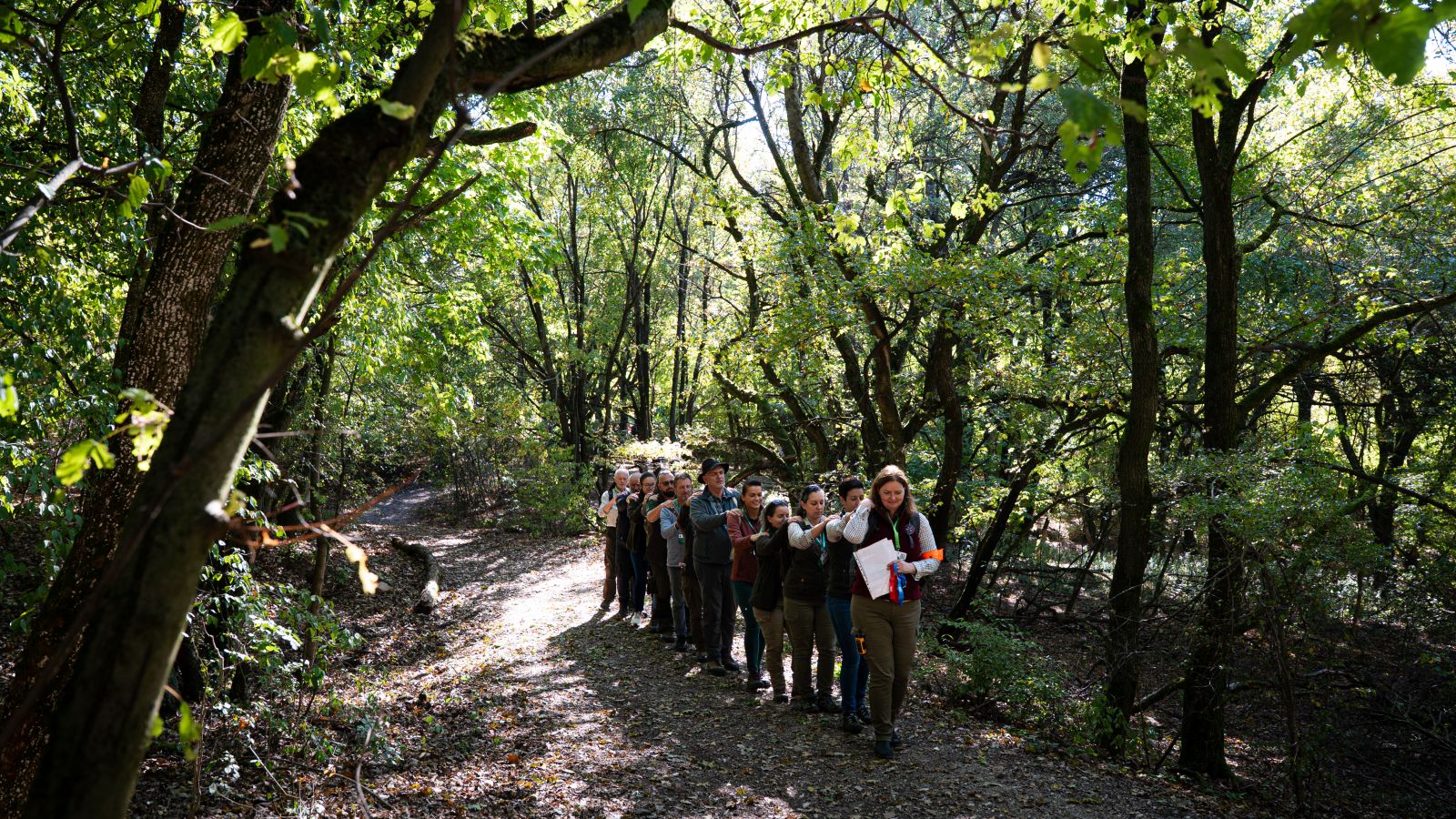
The experimental program aimed to explore how the digital and offline worlds appear in forest pedagogical practice. Two types of trails were compared: one built on experiential, sensory learning, and another that employed digital tools. Together, they clearly illustrated the differences between these two approaches and their possible points of connection.
Forest pedagogy fundamentally puts experiential, sensory-based learning at the center, so the purely experiential trail fitted well with the traditional values of the methodology.
The digital trail, in turn, introduced a new dimension to forest pedagogy by enabling the rapid, interactive processing of information, while at the same time raising the question of to what extent screen‑based learning distances participants from the direct experience of nature.
The experiences gained on the two trails highlighted that digital and offline approaches are not opposites, but can be complementary forms of learning when applied in the right proportion and with clear goals. The experiential trail mainly supported strengthening emotional attachment to nature, while the digital trail was more effective in expanding cognitive knowledge and data‑based understanding. According to participants’ feedback, direct sensory experiences left a deeper impression, whereas digital tools contributed to structuring knowledge and to reflective processing. 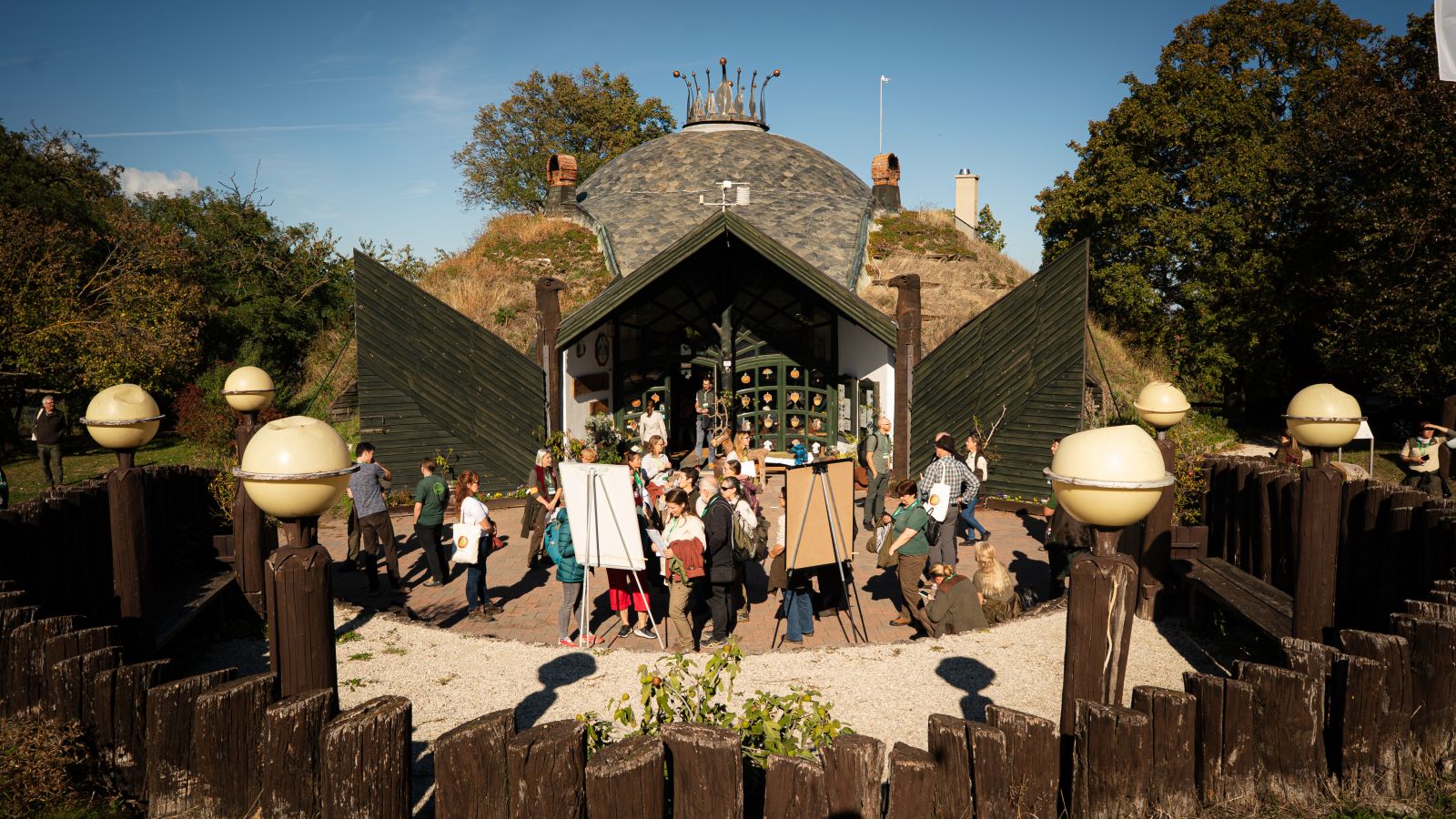
At the Madas László Forestry Forest school, Péter Szabó, chair of the forestry forest school section of the Hungarian Forestry Association, welcomed the guests and introduced them to the operation of the network of certified Hungarian forestry forest schools.
Workshops: Digital Tools and Direct Experience
On the second and third days of the conference, 15 workshops provided opportunities for participants to discuss whether digital tools could perhaps help involve children more effectively in forest pedagogical activities – and, if the choice is instead to exclude digital tools, how children’s interest can be aroused. What themes can offer children genuinely new experiences?
At the workshop of Maximilian Kropp and Daniel Dann, participants familiarized themselves with the “Waldwandel” application developed at the Haus des Waldes in Stuttgart. It combines augmented reality with forest education activities along a themed trail featuring interactive stations. Guided by virtual forest sprites, visitors can explore the forest and gain a deeper understanding of the connections between forests and climate change, while being encouraged to develop creative solutions.
The application is primarily aimed at families visiting the forest and encourages them to take part in short, playful activities, supported by forest pedagogy methods. The workshop participants agreed that although an app cannot replace the expertise of forest pedagogues, it can be a valuable complement, especially for occasional visitors such as families on weekend outings.
Eszter Véninger (VADEX Zrt.), Zsuzsanna Fajkuszné Bodrogi and Anett Somné Huszti (NYÍRERDŐ Zrt.) demonstrated in their workshop the possibilities for using smart devices in the field. Working in groups, participants used a phone application to identify tree species present at the site and, through playful learning and experiential pedagogical methods, were guided from the digital world toward close observation of nature. 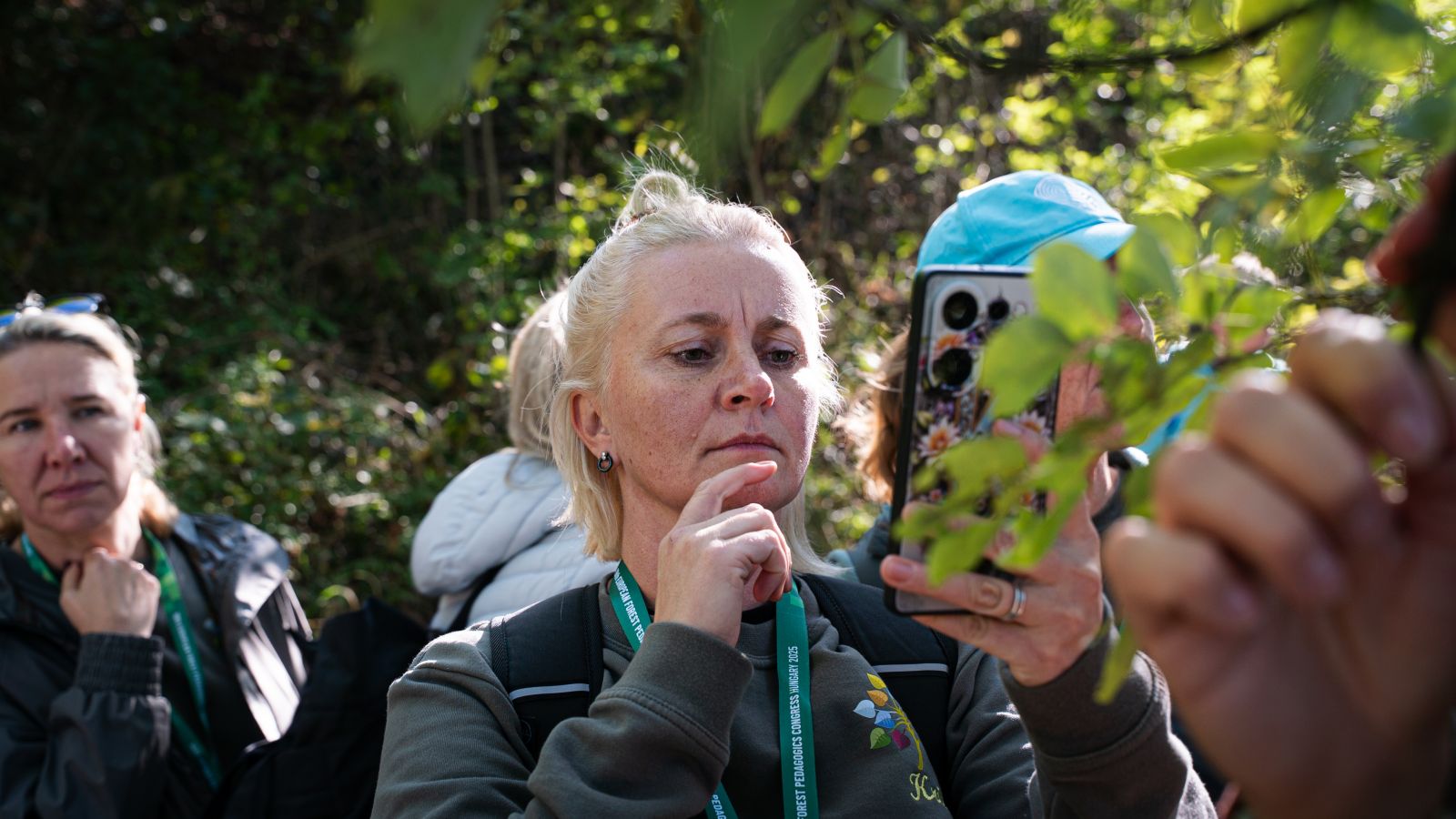
Eszter Csikós, head of a forest school (NEFAG Zrt.), led a session titled “Life in a Drop of Water,” in which participants examined tiny aquatic organisms taken from a puddle at the forest’s edge and from a forest pond. For this they used Bresser Junior microscope sets that can be connected to a computer so the whole group could see the projected image at the same time. Colleagues found this approach inspiring for discovering nature. A modern technical device was used to hold the attention of the “digital generation,” while live, moving creatures were observed – something much more engaging than looking at inanimate objects under a microscope.
Large Carnivores, Slow Pedagogy and Risk‑Taking
At the workshop run by Maja Sever, Iztok Tomazic, Ana Pšennicnik, Helena Mandelj Sneberger and Manica Kenda (Slovenia), experiential learning was linked to the protection of large carnivores. Over three stations, participants learned about predators’ hunting techniques, methods of field observation, and the photographic identification of lynx. Playful tasks and field research motivated young people, while the combination of practical activities in nature and digital tools supported learning. The workshop demonstrated how digital tools can be effectively used in nature‑related education and how interest in biodiversity conservation can be increased.
At the workshop of German forest pedagogue Bernd Nold, participants experienced how, in forest pedagogical activities, the forest itself can become the central element of learning and direct experience through conscious “doing nothing.” During this process, slowing down, calming inner restlessness and strengthening basic trust become key goals. The so‑called “slow lifestyle” has been gaining ground around the world for several years, and more and more people in Hungary also try to devote time to “slowing down.” Participants concluded that this slowing‑down approach can be transferred into forest pedagogical practice, as it can be adapted to the needs, time frames and ages of different groups.
A separate outdoor workshop by Eszter Kőkuti, head of a forestry forest school (Gemenc Zrt.), focused on risk‑taking, an area for which the forest is an excellent setting. Risky play does not mean the deliberate search for accidents, but rather children’s voluntary and exciting activities in which there is a possibility of physical or social/emotional injury, but which the children are capable of assessing and managing. 
Such activities are essential for children’s development, especially regarding emotional intelligence, cognitive abilities and motor coordination. Through risky play, children learn to assess, manage and accept risks, laying the foundations for responsible decision‑making in adulthood. The role of the forest pedagogue is crucial here: the aim is not to eliminate all risk, but to minimize dangers while creating a supportive, encouraging atmosphere. The playful sense of uncertainty and excitement can also serve as a means of childhood stress management and of preventing later anxiety.
Harmony, Birds and Cooperation
In their workshop, Krisztina Győrössy and Dr. Gabriella Földes‑Leskó (Eszterházy Károly Catholic University) presented the method of nature hiking for foresters and forest pedagogues as an outdoor learning approach rooted in forest pedagogy and guided by the theory of Harmony. Building on nature‑based networks, the workshop aimed to foster harmony within the individual, in social relationships and in the surrounding natural world. Participants explored the educational potential of hiking trails and took part in various activities and exploration‑based tasks that can support cognitive, emotional and social development.
The workshop held by Mrs. Andrásné Békefi and Luca Fenyvesi (Pilisi Parkerdő Zrt.) focused on birds. In a game, group members could step into the roles of various well‑known bird species. They learned their calls and acquired knowledge about them. In the first part of the game, they had to find their partners based on the bird sounds they produced. In the second part, they had to build a nest, which required considerable skill. In honor of the most skillful pair, they acted out a “bird wedding,” a German folk custom known as Vogelhochzeit. Participants from Germany even sang the little song that goes with the game.
Adrienn Scheitler (Mecsekerdő Zrt.) and Zsuzsanna Fajkuszné Bodrogi presented a matching game. Participants had to find their partners without speaking and without removing the cards pinned to their backs; they could only rely on help from others. There is some kind of relationship between each pair (for example: wild boar piglet – sow, spider – web, mole – molehill), which the matched players had to formulate together at the end. Besides learning new information, this game offered important opportunities to experience helping others and being accepted.
Fire, Music, Camps and Climate Games
In one part of his session, Dr. Dániel Nagy (NÉBIH – National Food Chain Safety Office) presented the mobile forest fire adventure course, a thematically structured mobile track that is experiential and motivating. Forest fires represent an increasing risk in Europe, so the emphasis is on prevention. The second part introduced the “Child‑friendly forest and forest‑friendly child” project. In a small community, an interesting forest site may be all that is needed for children to disconnect from the online world and get to know the forest – as every forest walk helps if there is a clear goal. This enables forestry units that do not have their own forest school or educational specialist to become involved in presenting the forest and forest management.
Lajos Szabó illustrated the experiences of the “Music in the Forest” (Muzsikál az erdő) event series over its 22 years of existence. Alongside traditional forest pedagogical methods, the series harnesses the power of music. Music and the arts affect emotions, have a mobilizing, community‑building force, and connect people and cultures. As a result, they can exert a stronger influence on attitude formation and reach a broader section of society.
Tímea Szikszainé Rácz and Boldizsár Kovács‑Molnár (Hungarian Forestry Association) presented the Hungarian Hiking Camp Program for Youth (Gyalogos Vándortábor Program), a nationwide initiative to support experiential outdoor learning in nature. Coordinated by the Hungarian Forestry Association, the program aims to ensure that primary and secondary school students, during one‑week hiking camps along various routes across the country, come into direct contact with nature while also gaining community and self‑knowledge experiences.
The presentation emphasized that the hiking camp is not just a trip, but a consciously structured pedagogical process in which hiking, community building and environmental education are closely intertwined. The programs focus on developing knowledge of nature, environmental awareness and cooperative skills. Besides hiking, campers take part in educational sessions, local cultural programs and team‑building games. Particular emphasis is placed on responsible behaviour in nature, ecological attitude formation and learning based on personal experience.
Andrea Vígh (Pilisi Parkerdő Zrt.) presented a continuous‑cover forestry model table. Using the model, concepts related to forest management – such as the clear‑cutting system and continuous‑cover (selection) forestry – can easily be demonstrated for children, along with biological and conservation knowledge.
In their workshop on “Climate Game – Sustainable Development Goals,” Bastian Engel and Bettina Foerster Baldenius (Germany) used playful methods to introduce participants to the Sustainable Development Goals and the importance of climate protection. Actions serving climate protection or even halting climate change often appear to be impossible challenges, especially for children and young people. To ease this, they developed an interactive, cooperative game that allows participants to experience the usefulness of their actions and to gain positive experiences.
At a further workshop, Katja Konecnik and Andreja Gregoric focused on sustainable forest management, presenting the forest as a renewable natural resource. For the duration of the activity, participants became forest owners and made decisions about forest management. They experienced first‑hand the consequences of their decisions and came to understand that today’s decisions and actions have immediate impacts on nature, on the land of neighbouring forest owners, and, in the longer term, on themselves and future generations.
Conclusions and Cultural Experiences
 Participants in the conference agreed that forest pedagogy is an excellent tool that, through the senses, movement and direct experience, helps children become familiar with the offline world. It can contribute to expanding their social relationships and to developing their personalities. In addition, projects aiming at education for sustainability can be made more effective by using the tools and methods of forest pedagogy.
For the future of forest pedagogy, an important question is whether digital tools can be integrated without losing its fundamental experiential‑pedagogical character. Research results and the experiences from experimental trails and workshops suggest that the conscious inclusion of the digital world can help reach younger generations, but the authentic experience of being present in nature must be preserved.
Naturally, alongside the professional program, there was time to introduce participants to the richness of Hungarian culture. The program included folk music and folk dance performances, wine tasting, guided visits to Visegrád’s attractions and even some “medieval” team‑building activities. As a farewell, those interested could take part in a sightseeing tour of Budapest.
At the closing evening of the conference, the baton was passed to the Austrian colleagues, who invited the forest pedagogy community to next year’s congress in Austria, in the Traunsee region.
Videos:
https://www.youtube.com/watch?v=3ElBoYdBPKI
https://www.youtube.com/watch?v=-Hi-ZS0K1aw
Authors, Photos and Acknowledgements
Authors: Szilvia Seres, Kata Kenderes, Eszter Pintér, Tímea Szikszainé Rácz / Hungarian Forestry Association (OEE)
Photos: Bálint Bárdi
Grateful thanks are extended to the Ministry of Agriculture for its support, as well as to the forest pedagogues who contributed to the organization and professional leadership:
Békefi Andrásné, Eszter Csikós, Margit Dénes, Zsuzsanna Fajkuszné Bodrogi, Luca Fenyvesi, Dr. Eszter Horváth, Eszter Kőkuti, Zsuzsanna Makra, Adrienn Scheitler, Anett Somné Huszti, Lajos Szabó, Tímea Szikszainé Rácz, Dr. Viktor Takács, Eszter Véninger, Andrea Vígh.
The organization and implementation of the event were carried out by the staff of the Secretariat of the Hungarian Forestry Association:
Tamás Elmer, Dóra Benyóczki‑Wenczel, Veronika Janusch, Fruzsina Kaszab, Csaba Kecskés, Dr. Kata Kenderes, Boldizsár Kovács‑Molnár, Marianna Olmosi, Eszter Pintér, Annamária Udvardi.